
Industrial Check Valves
In an axial flow check valve, the disc travels a short distance inside a diffuser on the flow axis and, assisted by a spring, closes just before flow stops. This largely prevents the slam and pressure surge seen with swing check valves; it is preferred at compressor and pump discharges and on large-diameter pipelines.
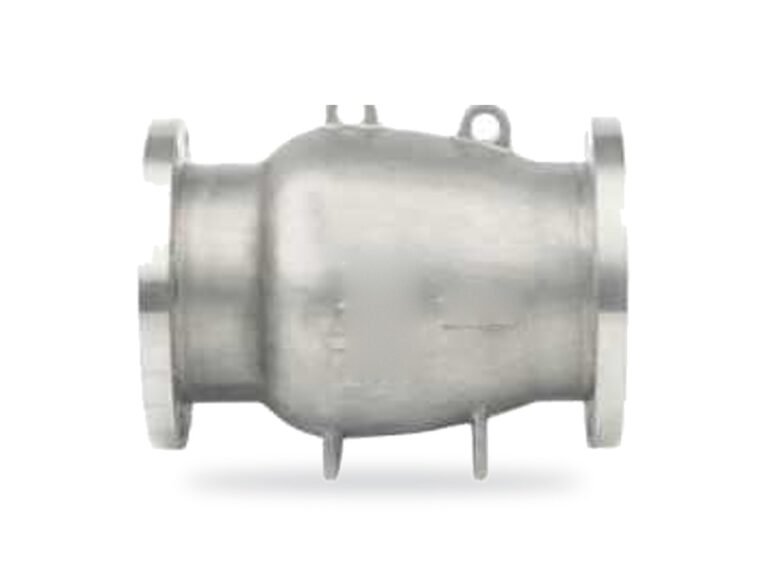
Overview
The venturi-shaped flow path in the body guides the fluid smoothly around the disc, so the pressure drop is markedly lower than that of a swing check valve of the same size. The disc stroke is short and the spring constantly pushes the disc toward the seat; as flow slows, the disc closes before reverse flow begins. The result is non-slam, quiet closing and protection of pumps and compressors against reverse rotation.
On request, the face-to-face dimension can be made the same as that of a swing check valve (ASME B16.10); an existing swing check valve can then be replaced by an axial flow check valve without modifying the pipeline. It can be used in horizontal lines and in vertical lines with upward flow. Where a more compact and lighter solution is needed, a dual plate (wafer) check valve is an alternative; see also check valve types explained.
Technical specifications
| Size | 2″–60″ (DN50–DN1500) |
|---|---|
| Pressure class | ASME Class 150–1500 |
| End connections | RF / RTJ flanged (ASME B16.5 / B16.47), butt-weld (ASME B16.25) |
| Design | API 6D, ASME B16.34 |
| Face-to-face | ASME B16.10 on request (same length as a swing check valve); short pattern option |
| Materials | A216 WCB, A351 CF8M, A995 4A (duplex); other alloys on request |
| Seat | Metal-to-metal, CoCr hard-faced |
| Installation | Horizontal line or vertical line with upward flow |
Key features
- Spring-loaded, short-stroke disc: closes before reverse flow begins
- Protection against slam and pressure surge
- Low pressure drop through the venturi body
- Swing check face-to-face option: replacement without line modification
- Construction resistant to vibration and pulsation
Face-to-face dimensions (mm)
On request, axial flow check valves can be supplied with the same flanged face-to-face dimension as swing check valves (ASME B16.10); in this option they replace an existing swing check valve without piping modification. The values below apply to this option; dimensions of short-pattern designs are given with the quotation.
| NPS | DN | Class 150 | Class 300 | Class 600 |
|---|---|---|---|---|
| 2 | 50 | 203 | 267 | 292 |
| 2½ | 65 | 216 | 292 | 330 |
| 3 | 80 | 241 | 318 | 356 |
| 4 | 100 | 292 | 356 | 432 |
| 6 | 150 | 356 | 444 | 559 |
| 8 | 200 | 495 | 533 | 660 |
| 10 | 250 | 622 | 622 | 787 |
| 12 | 300 | 698 | 711 | 838 |
| 14 | 350 | 787 | 838 | 889 |
| 16 | 400 | 864 | 864 | 991 |
| 18 | 450 | 978 | 978 | 1092 |
| 20 | 500 | 978 | 1016 | 1194 |
| 24 | 600 | 1295 | 1346 | 1397 |
Values are for raised-face (RF) flanged ends and conform to ASME B16.10. Ring-type joint (RTJ) ends are slightly longer; butt-weld (BW) end-to-end dimensions are listed separately in the standard. Exact dimensions are shown on the general arrangement (GA) drawing supplied with the quotation.
Face-to-face dimensions, high-pressure classes (mm)
| NPS | DN | Class 900 | Class 1500 |
|---|---|---|---|
| 2 | 50 | 368 | 368 |
| 3 | 80 | 381 | 470 |
| 4 | 100 | 457 | 546 |
| 6 | 150 | 610 | 705 |
| 8 | 200 | 737 | 832 |
| 10 | 250 | 838 | 991 |
| 12 | 300 | 965 | 1130 |
| 14 | 350 | 1029 | 1257 |
| 16 | 400 | 1130 | 1384 |
| 18 | 450 | 1219 | 1537 |
| 20 | 500 | 1321 | 1664 |
| 24 | 600 | 1549 | 1943 |
Part materials
| Part | Material options |
|---|---|
| Body, diffuser, disc | A216 WCB, A351 CF8M, A995 4A (duplex) |
| Bearing (bushing) | Stainless steel, duplex stainless |
| Spring | SS316, Alloy X-750, Alloy 718 |
| Seat | Metal-to-metal, CoCr hardfaced (disc and body seat) |
Documentation and testing
On industrial projects the documentation package matters as much as the valve. We confirm the certificate and test scope for every line item at quotation stage:
- EN 10204 3.1 material certificates for pressure-retaining and wetted parts, traceable by heat number
- EN 10204 3.2 with third-party inspection, on request
- Pressure test reports to API 598 or EN 12266-1: shell, seat and, where specified, gas tests
- Fire-test certificates (API 607 / ISO 10497) for fire-safe type-tested designs
- PMI reports for alloy and stainless materials
- Dimensional, visual and coating inspection records
- PED 2014/68/EU CE declaration for equipment within its scope
- NACE MR0175 / ISO 15156 compliance statement for sour (H₂S) service
Technical datasheet
Frequently Asked Questions
What is the difference between an axial flow check valve and a swing check valve?
In a swing check valve the disc travels through a wide arc and often closes after reverse flow has started, which can cause slam and pressure surge. In an axial flow check valve the disc closes over a short distance with spring assistance, before flow stops. The result is non-slam, quiet closing and lower pressure drop.
Why is an axial flow check valve preferred at compressor discharge?
When a compressor stops, gas backflow develops very quickly; a check valve that closes late can cause the compressor to run in reverse and be damaged. The short-stroke, spring-loaded disc of an axial flow check valve closes quickly to protect the compressor and operates stably in pulsating flow.
Related products
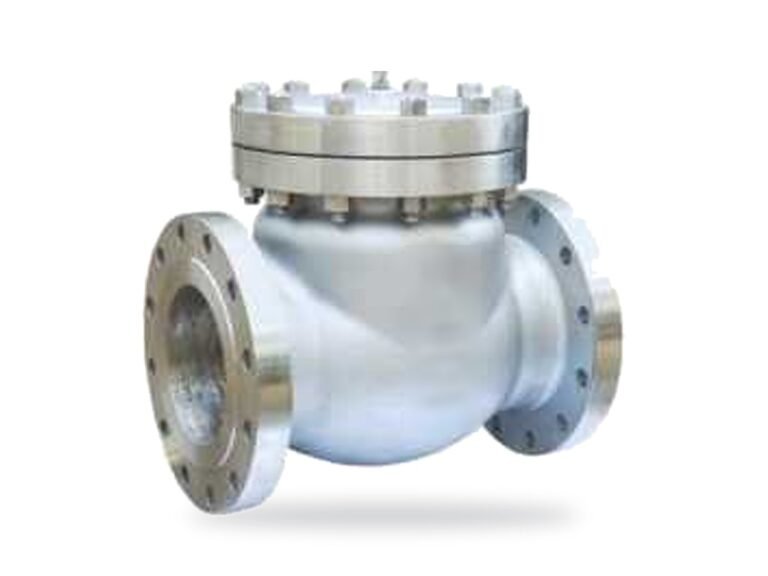
Swing Check Valve
Bolted bonnet, renewable seat; low pressure drop, piggable option.
View details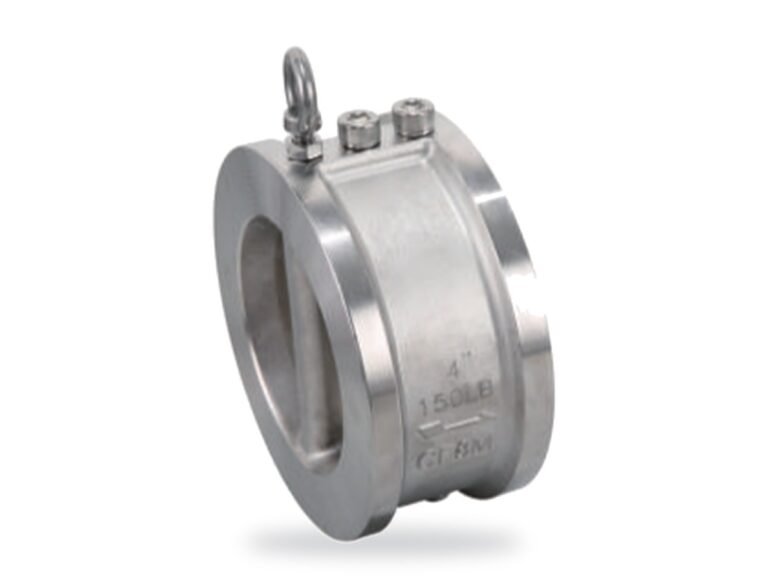
Dual Plate Wafer Check Valve
API 594; spring-assisted fast closing, short length; wafer, lug or flanged.
View detailsRequest a quote: Axial Flow Nozzle Check Valve
Share your valve list, datasheet or project specification. We review standards, materials and documentation line by line and return an itemized offer, with any deviation from the specification stated in writing.