
Industrial Strainers
A Y strainer is a compact filtering element in which the screen chamber sits on an angled branch of the body. Installed upstream of pumps, control valves, steam traps and instruments, it captures weld slag, rust and particles in the line.
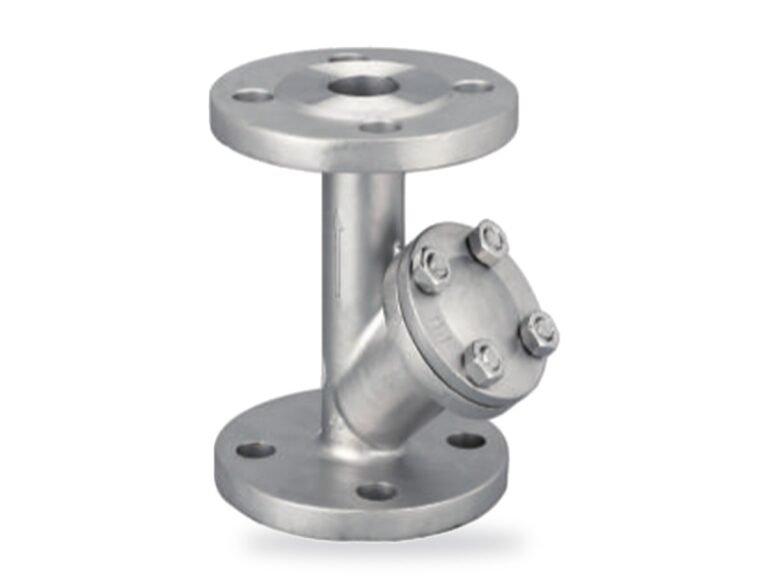
Overview
On liquid lines the screen leg is installed pointing down; on steam and gas lines it is installed horizontally, pointing sideways. With a valve fitted to the blow-off connection on the screen cover, partial cleaning can be done during operation. The screen opening is selected for the protected equipment; with fine screens, a differential pressure gauge is recommended. For a comparison with basket and duplex strainers, see our strainer selection guide.
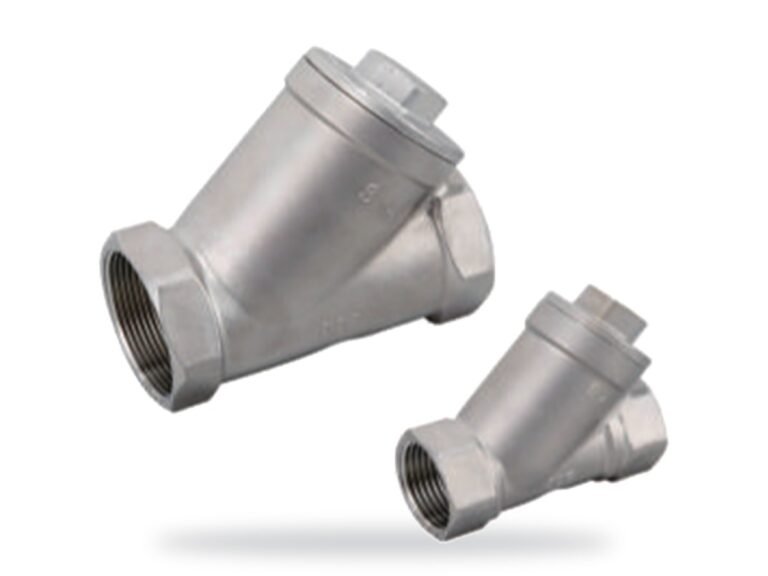
Technical specifications
| End connections | Flanged (EN 1092-1 / ASME B16.5), threaded, butt-weld |
|---|---|
| Pressure rating | PN16, PN40; Class 150, 300 |
| Body | WCB / A105, CF8 / CF8M |
| Screen | 304 / 316 perforated plate or wire mesh |
| Options | Blow-off connection, magnetic insert, differential pressure gauge connections |
Key features
- Compact and economical
- Horizontal and vertical (downward flow) installation
- Cleaning in operation via blow-off
Documentation and testing
On industrial projects the documentation package matters as much as the valve. We confirm the certificate and test scope for every line item at quotation stage:
- EN 10204 3.1 material certificates for pressure-retaining and wetted parts, traceable by heat number
- EN 10204 3.2 with third-party inspection, on request
- Pressure test reports to API 598 or EN 12266-1: shell, seat and, where specified, gas tests
- Fire-test certificates (API 607 / ISO 10497) for fire-safe type-tested designs
- PMI reports for alloy and stainless materials
- Dimensional, visual and coating inspection records
- PED 2014/68/EU CE declaration for equipment within its scope
- NACE MR0175 / ISO 15156 compliance statement for sour (H₂S) service
Technical datasheet
Frequently Asked Questions
How is the screen opening of a Y strainer selected?
By the largest particle size the protected equipment can tolerate. Perforated plate is generally used for pumps, finer wire mesh for control valves and instruments. The finer the screen, the faster it clogs and the higher the pressure drop.
Related products
Request a quote: Y Strainer
Share your valve list, datasheet or project specification. We review standards, materials and documentation line by line and return an itemized offer, with any deviation from the specification stated in writing.