Heat Pumps and Hydronic Balancing in Cold Climates
How proper hydronic balancing helps heat pumps run more efficiently in regions like Ontario, Québec,
and the U.S. Northeast & Midwest – with CAD-based cost and emissions estimates.
1. Why Heat Pumps and Hydronic Systems Work Well Together
In cold-climate regions such as Toronto, Montréal, New York, Boston, Chicago or Minneapolis, hydronic distribution systems
(radiators, fan coils, floor heating) are very common. Over the last years, many projects have started replacing or supplementing
traditional boilers with air-to-water or water-to-water heat pumps.
Heat pumps are most efficient when the required temperature lift is small. In practice this means:
- Lower supply water temperatures (for example 35–50 °C instead of 70–80 °C)
- Stable and relatively low return temperatures
- Good control of flow and delta-T across the hydronic loops
Hydronic balancing is the tool that helps achieve this: it ensures each loop and terminal unit receives the right flow and that
flow is not “wasted” in short-circuits or over-pumped branches. The result is more stable delta-T and lower average return
temperatures – ideal operating conditions for heat pumps.
2. Hydronic Balancing Valves and Their Calculations
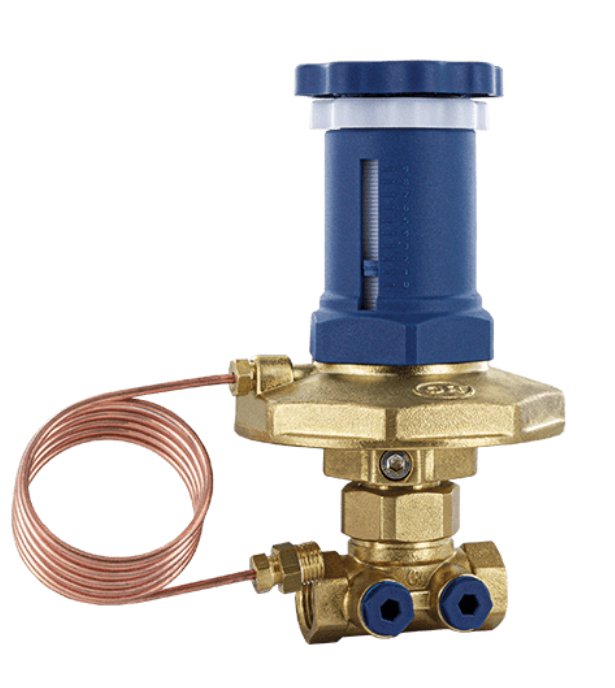
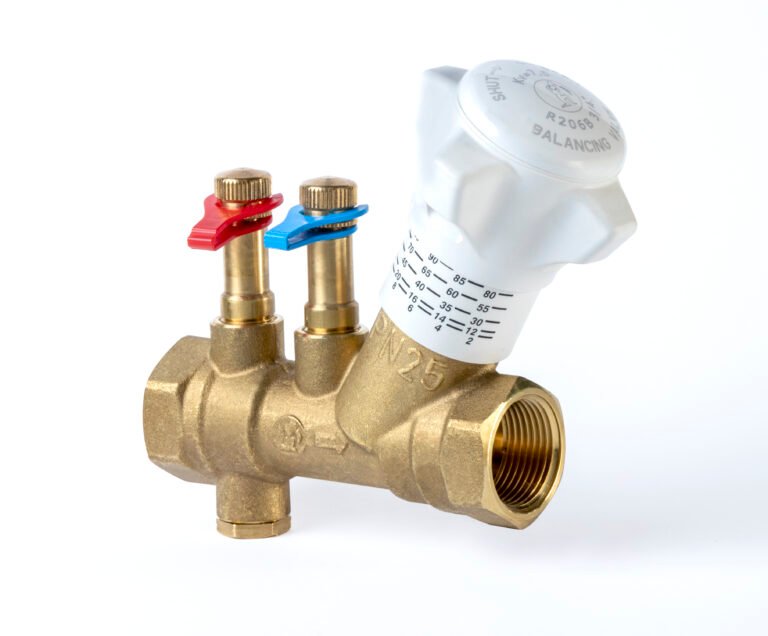
Hydronic balancing valves are used to set and verify flow in each branch of a heating or cooling system. The basic
sizing relation most engineers work with is:
Q = Kv × √ΔP

Where:
Q  = Flow rate (m³/h)
Kv = Valve flow coefficient
ΔP = Pressure drop across the valve (bar)
Once the design flow and available differential pressure are known, the required Kv can be calculated and a suitable
balancing valve selected from manufacturer data. Your dedicated article on hydronic balancing valves can provide detailed
calculators for Q–ΔP–Kv and pump power – this article focuses on how that balancing improves heat pump performance.
3. Combined Impact in Cold-Climate Buildings
Real-world studies in Canada, the U.S. and Europe give a good picture of what to expect when heat pumps and hydronic
systems are designed and operated correctly:
- Field and modelling studies of air-source heat pumps in cold climates report seasonal COPs typically in the range of about
2.0–3.5 for mild-to-cold conditions, and above roughly 1.5 at very low outdoor temperatures with modern
cold-climate units. - Guidance from Natural Resources Canada and Canadian municipalities notes that air-to-water heat pumps operate more efficiently
when supplying water at lower temperatures (below roughly 45–50 °C), which is easier to achieve in well-balanced, low-temperature hydronic systems. - Hydronic balancing requirements in ASHRAE 90.1 make proportional balancing and subsequent pump speed or impeller
adjustment a standard step for code-compliant systems, reflecting the strong link between system balance, delta-T and plant efficiency. - Case studies on hydronic optimization and distributed pumping indicate potential reductions in pump and plant energy broadly in
the 15–30 % range when low delta-T and over-pumping issues are corrected in existing buildings.
For a practical rule-of-thumb: if hydronic balancing and controls allow the heat pump’s seasonal COP to improve from, say,
2.5 to 3.0 in a cold climate, and pump optimization also reduces pump kWh, the combined impact can be thousands of kWh and
hundreds to thousands of CAD per year in larger multifamily or commercial buildings.
4. Heat Pump & Balancing Benefit Estimator (CAD & CO₂)
Use the calculator below to estimate how much electricity, cost (in CAD) and approximate CO₂ emissions you could save
when hydronic balancing allows your heat pump to run at a higher COP. This is a simplified engineering estimate for
preliminary studies in cold-climate hydronic buildings.
Preset scenarios:
You can start from a preset and then adjust the numbers for your project.
Heat Pump + Hydronic Balancing Calculator
Compare an unbalanced hydronic system with a balanced one by adjusting the heat pump COP values.
Enter your design data and click Calculate.
Example: 2.5
Example: 3.0
Example: ~0.04 for Ontario grid mix
Results
– kWh (thermal)
– kWh/year
– kWh/year
CAD –/year
CAD –/year
– kWh/year
CAD –/year
– %
– tonnes/year
– tonnes/year
– tonnes/year
Visual comparison (annual electricity use):
Unbalanced
Balanced
Bars are scaled relative to the unbalanced case (100%).
Interpretation: A relatively small improvement in COP (for example from 2.5 to 3.0) can translate into meaningful
annual electricity, cost and CO₂ savings, especially in cold-climate buildings with long heating seasons and a low-carbon
electricity grid such as Ontario’s.
represent the seasonal behaviour of the system. For detailed design and investment decisions, full energy modelling and
local code review are recommended.
4.1 Example Scenario – Ontario Detached House with a Cold-Climate Heat Pump
The following example illustrates how hydronic balancing can affect annual electricity use, cost and emissions in a typical
cold-climate house in Ontario using a cold-climate air-source heat pump with a hydronic distribution system.
- Location: Greater Toronto Area (cold Canadian climate)
- Building: Detached house with hydronic distribution (radiators or floor heating)
- Design heating load: 12 kW
- Annual full-load equivalent hours: 3 000 h/year (36 000 kWh thermal per year)
- Electricity price: 0.15 CAD/kWh
- Grid emission factor: 0.04 kg CO₂/kWh
- Case A – Unbalanced hydronic system: seasonal COP ≈ 2.5
- Case B – Balanced hydronic system: seasonal COP ≈ 3.0
Result: electricity savings ≈ 2 400 kWh/year, cost savings ≈ 360 CAD/year,
CO₂ reduction ≈ 0.096 t/year for a single house – without even counting pump energy savings.
5. Sustainability and System-Level Benefits
At the single-building scale, the savings from hydronic balancing and efficient heat pumps may look modest. At the scale
of a city or country, they become extremely important. Several studies for Canada and other cold-climate countries show that:
- Buildings contribute roughly 12–15% of Canada’s national GHG emissions, much of it from fossil-fuel heating.
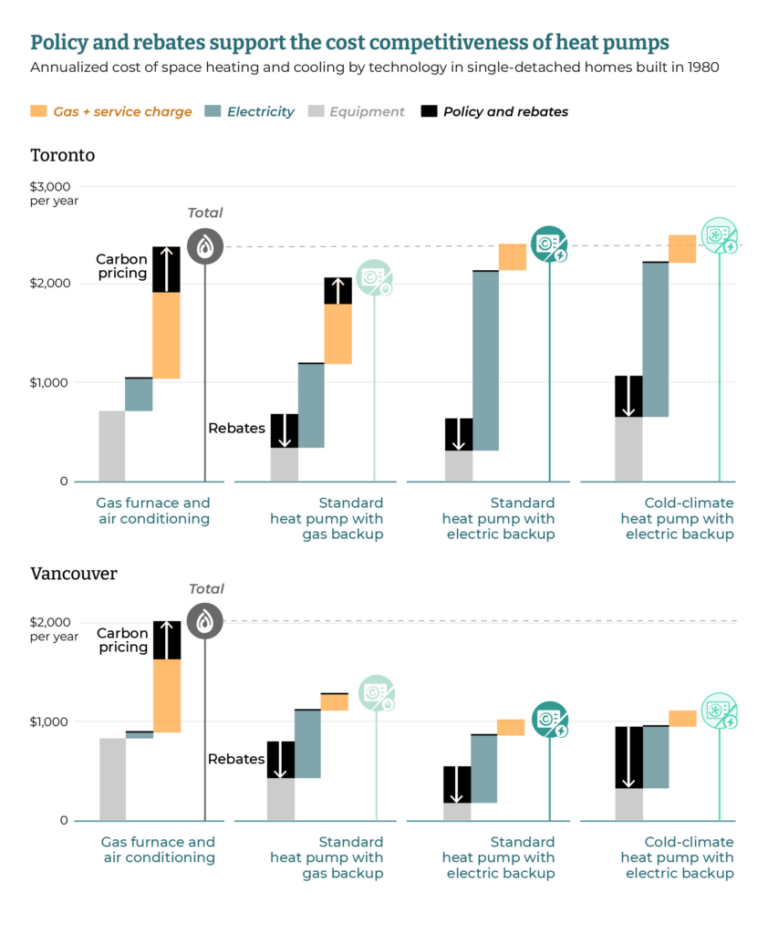
- Replacing fossil-fuel boilers with heat pumps on a low-carbon grid (like Ontario’s) can reduce direct heating emissions by 60–80% or more.
- Canadian Climate Institute analysis suggests that widespread heat pump adoption in existing homes can cut emissions by several megatonnes CO₂/year by 2030–2050.
- Hydronic balancing further improves the effective COP of heat pumps and reduces pumping energy, lowering electricity demand and easing pressure on the grid.
In other words, hydronic balancing valves, properly sized pumps and efficient heat pumps are not only a building-level
engineering detail – they are part of the country’s long-term decarbonization strategy.
If you would like project-specific support, the ValveAtlas team can help with product selection and hydronic balancing strategies
for heat-pump-based systems in cold climates.
Contact Valve-Atlas Engineering Team
6. References & Further Reading
- Natural Resources Canada – Heating and Cooling with a Heat Pump
– overview of heat pump operation in Canadian climates and the benefit of lower supply temperatures. - Canadian Climate Institute – Heat Pumps Pay Off
– technical and economic analysis of heat pumps, seasonal COP and emissions reductions in Canadian cities. - City of Toronto – Heating & Cooling with a Heat Pump.
- Environment and Climate Change Canada – National Greenhouse Gas Emissions.
- IESO – Ontario’s Electricity Grid.
- Hydronic balancing & pump trimming summary – based on ASHRAE 90.1 guidance and industry technical notes.